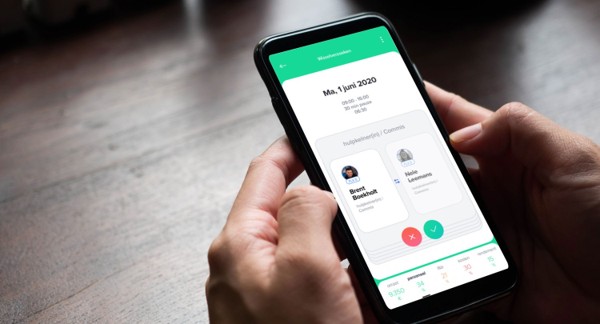
Track employee working hours accurately with AAPI TIME. Compare planned and actual hours, manage breaks and overtime, and connect time tracking directly with payroll.
FAQ - Employee Time Tracking Software Belgium | AAPI TIME
How to track employee working time with AAPI?
Knowing when employees are scheduled is important.

Knowing when they actually work is essential.
AAPI TIME is AAPI’s digital time tracking solution. Employees clock in and out while AAPI records their actual working time and interprets those hours against the schedule and contractual working hours.
Instead of manually collecting timesheets at the end of the month, working time becomes part of one connected workflow.
Planning → Time Tracking → Payroll
What is AAPI TIME?
AAPI TIME is a digital time clock designed to register and interpret employee working hours.
Employees use the system to register important moments during their working day, including:
- starting work
- ending work
- starting a break
- returning from a break
AAPI then compares those registrations with the employee’s planned and contractual working hours.
This gives employers a clearer view of planned hours versus actual hours worked.
How does employee time tracking work with AAPI?
The basic process is straightforward:
- Plan the employee. The expected working hours are defined through AAPI Planning.
- Employee clocks in. The actual start time is registered.
- Breaks are registered. Employees clock out and back in where required.
- Employee clocks out. The actual end time is recorded.
- AAPI interprets the hours. Registered time is compared with planning and contractual hours.
- Differences can be processed. Managers can review deviations before payroll.
- Approved hours feed into payroll.
This removes much of the manual work normally required to turn working hours into payroll information.
How does AAPI compare planned and actual working hours?
AAPI TIME does more than record a clock-in and clock-out.
The registered hours are interpreted against the employee’s schedule and contract.
This makes it possible to identify situations where:
- an employee starts earlier
- an employee finishes later
- actual hours differ from the schedule
- overtime may have occurred
- registered hours need to be reviewed
AAPI therefore connects what was planned with what actually happened.
How are time tracking conflicts handled?
Sometimes planning, contractual information and time registration do not match.
AAPI allows managers to process these differences and determine which hours should be used.
Depending on the situation, the manager can work with:
contract or Dimona hours → registered working time → manually adjusted hours
Regularly reviewing these differences helps prepare the correct information for payroll.
How does time tracking connect with payroll?
Accurate working hours are one of the foundations of accurate payroll.
AAPI connects time registration with its wider payroll workflow.
Instead of manually collecting hours from paper, Excel or separate time sheets, managers can review and approve the working time already recorded in AAPI.
The workflow becomes:
contract → planning → clocking → approved hours → payroll
AAPI PLAY can then use the relevant approved working hours when preparing payroll information for the social secretariat.
Can AAPI TIME track breaks?
Yes.
Employees can register the start and end of breaks through the time clock.
This gives AAPI a more accurate view of the time actually worked during the shift rather than simply calculating the difference between arrival and departure.
Paid and unpaid breaks can also form part of the wider contract and time interpretation.
Can AAPI track overtime?
AAPI can identify differences between scheduled, contractual and registered working hours.
These differences can then be reviewed as part of the performance and payroll workflow.
This gives managers more control over extra hours instead of discovering them only when payroll needs to be processed.
Where do employees clock in?
AAPI TIME can be installed on a designated tablet or smartphone at the workplace.
This means employees can use a central device rather than having to use their personal phone.
AAPI also describes the system as supporting mobile use, PIN-code security and offline functionality for relevant environments.
Why connect time tracking with planning?
A standalone time clock tells you when someone arrived and left.
A connected time clock can tell you whether that matches what was supposed to happen.
Because AAPI combines Planning and Time Tracking, employers can compare:
scheduled hours vs contractual hours vs actual hours
That makes registered time more useful for operational control and payroll processing.
What is the difference between Planning and Time Tracking?
The distinction is simple:
Planning: When is the employee supposed to work?
Time Tracking: When did the employee actually work?
Combining both gives managers a more complete view of employee performance.
Why use digital time tracking instead of paper or Excel?
Manual timesheets require someone to collect, check, interpret and re-enter working hours.
With AAPI TIME, working hours are registered digitally and connected with the employee, schedule and payroll workflow.
That means fewer disconnected steps:
clock → compare → approve → payroll
instead of:
write → collect → calculate → check → re-enter → payroll
Frequently asked questions about time tracking
What is employee time tracking software?
Employee time tracking software records when employees start and finish work and helps employers calculate actual working hours.
Can employees clock in and out with AAPI?
Yes. Employees can use AAPI TIME to clock in and out digitally.
Does AAPI TIME compare actual hours with the schedule?
Yes. AAPI interprets registered time against planning, contractual hours and deviations.
Does time tracking connect with payroll?
Yes. Registered and approved working hours can become part of AAPI’s payroll workflow.
Can AAPI handle differences between planning and time registration?
Yes. Managers can review planning conflicts and determine whether contract/Dimona hours, time registration or manually adjusted hours should be used.
Is AAPI TIME only for hospitality?
No. AAPI currently positions its time tracking functionality across multiple sectors, including hospitality, retail, catering and events, hotels, industries and services.
From planned hours to actual hours
A schedule tells you what should happen.
Time tracking tells you what really happened.
With AAPI TIME, working hours are registered, compared with planning and prepared for the next step in the workforce process.
Plan the shift. Track the hours. Approve the result. Connect it with payroll.